Wednesday, October 19, 2005

For Vince!

In my last couple of entries I've gotten rather high flown about writing.  Time to touch the ground again.

Vince, at To Grow Is To Be Anxious, this one's for you!

Thank you, Vince, for introducing me to Becker's Denial of Death and for sharing your poetry with us.  Your poetry teaches us much about what it means to be human.  And Becker's is truly a life-changing book.  I think Becker would agree with the following quote from Kurt Vonnegut's new book, A Man Without A Country:

"The arts are not a way to make a living.  They are a very human way of making life more bearable.  Practicing an art, no matter how well or badly, is a way to make your soul grow, for heaven's sake.  Sing in the shower.  Dance to the radio.  Tell stories.  Write a poem to a friend, even a lousy poem.  Do it as well as you possibly can.  You will get an enormous reward.  You have created something."

I also must include the following quote from Vonnegut's book:

"Here is a lesson in creative writing.

"First rule:  Do not use semicolons.  They are transvestite hermaphrodites representing absolutely nothing.  All they do is show you've been to college."

*Note:  I believe I was a senior in college before I fully understood the purpose of a semi-colon.  When I told our youngest son the Vonnegut quote, he laughed and then said, "But semi-colons are so cool!"  (He is a newly minted senior in college).  Semi-colons do abound in essay writing and academic writing.  They are used much less often in poetry and fiction.  I believe what Vonnegut is proposing is not a hard-and-fast rule, but a break from high fallutin' academic writing.  It may be an interesting experiment to pay attention the next time you read a poem or story and see how many semi-colons are used.  I think it helps writers to pay attention to things like that, and that's why I included the quote in this entry.  I wanted people to think a bit about punctuation and what certain marks of punctuation represent. 

(I found, as did our son, that once you figure out what semi-colons are and how to use them, they become addictive.)

I think what Vonnegut would have us ask ourselves is why we are using the semi-colon.  If we're using it to show we know how (i.e. I'm a college graduate), then it serves no useful purpose.

Sunday, October 16, 2005

Walt Whitman and the Civil War

Photos: 

#1  Mock war encampment on the Maumee River at the Applebutter festival in Grand Rapids, Ohio.  October 9. 

#2  Allen (my husband) with our dog, Buddha, at the festival. 

#3  The Maumee.on the day of the festival.  I was surprised at how low the water level was.

~~~~~~~~~~~~~~~~~~~~~~~~~~~~~~~~~~~~~~~~~

I've only lived in two states, North Carolina and Ohio.  Both states (in part) define themselves by which side they were on in the Civil War.  

Last Sunday, Allen, Buddha (our dog), and I went to the Applebutter Festival in Grand Rapids, Ohio.  Every year, the festival draws thousands, who come for the brats, the hot Apple Cider, the Applebutter, the crafts, and the historic reenactments.  Every year, people dress in Civil War clothes (Union outfits) and display themselves in encampments beside the Maumee River.   It's a step back in time, sort of.

Recently, I've been taking another step back in time.  I've been reading Walt Whitman's Specimen Days.  It is a collection of his stray writings, including writings from his Civil War days, the days he spent comforting wounded and dying soldiers.

I've lived in the South and now I live in the North.   I know the Civil War was about having to choose a side.   It was about being patriotic, about loving your home, your "country."

Yet I once read somewhere that a true writer has no country.  It's always a danger to take quotes out of context, but I believe what was meant by that was that a writer has to be true to a higher calling than governments or politics. 

Walt Whitman was surely such a writer.  Oh, he loved America and rhapsodized about America.  But it was an idealized America.  I believe he thought America should be true to a higher calling, too, a higher  calling than power.

The following lines help to illustrate the higher calling Whitman  answered:

"I staid to-night a long time by the bedside of a new patient, a young Baltimorean, aged about 19 years. ... very feeble, right leg amputated, can't sleep hardly at all--has taken a great deal of morphine, which, as usual, is costing more than it comes to.  Evidently very intelligent and well bred--very affectionate--held on to my hand, lingering, soothing him in his pain, he says to me suddenly, 'I hardly think you know who I am--I don't wish to impose upon you--I am a rebel soldier.'  I said I did not know that, but it made no difference.  Visiting him daily for about two weeks after that, while he lived, (death had mark'd him, and he was quite alone,) I loved him much, always kiss'd him, and he did me."

Whitman's higher calling was to humanity.  I hesitate to say his higher calling was to God, because I don't think Whitman defined himself that way.  I think he was very spiritual, just not religious in the way we've come to think of being religious.  

One day Whitman ministered to a dying soldier who asked Whitman to read to him from the New Testament.  Whitman wrote in Specimen Days:

"The poor, wasted young man ask'd me to read the following chapter... how Christ rose again.  I read very slowly, for Oscar was feeble.  It pleased him very much, yet the tears were in his eyes.  He ask'd me if I enjoy'd religion.  I said, 'Perhaps not, my dear, in the way you mean, and yet, may-be, it is the same thing.'"

I know I would like to be the kind of person and the kind of writer that Walt Whitman was.  Mostly, I'm drawn to his never-ceasing optimism.  Even in the face of ugliness and brutality and death, Whitman never lost his belief in humanity.   He believed all was holy.  He believed we were all connected to one another and to nature and that is what divinity was to him. 

In one of his nature jottings, Whitman said:  "What is happiness, anyhow?  Is this one of its hours, or the like of it?--so impalpable--a mere breath, an evanescent  tinge?  I am not sure--so let me give myself the benefit of the doubt."

How like Whitman to ask, Am I happy?  And, not being sure, to give himself the benefit of the doubt.

That's the way I want to be.

As a writer, I, too, want to be moved by a high calling.  I think this is where anyone who is thinking about being a writer needs to begin, by asking, "What is it to which I want to be true?  What calling?"

Wednesday, October 12, 2005

Challenge

Engraving by Albrecht Dürer

Challenge:  The quality of requiring full use of one's abilities, energy, or resources.

~~~~~~~~~~~~~~~~~~~~~~~~~~~~~~~~~~~~~~~~

My, but I was extremely moved by the response the last entry got:  thank you, everyone, for making the effort to click on over here and leave a comment.  Now that I have your attention... (smile)

I thought I would issue a challenge to you bloggers out there, a challenge to look through your archives and mark a moment of change.  What I'm asking you to do is to  identify an entry that illustrates a turning point for you and your journal.  Identify an entry that suddenly set your journal off on a new direction, one never dreamed of before.

My own journal is just a little over a year old.  If you go back to my earliest entries you'll see they are rather sparse little things.  In the beginning, the journal was a way to capture fugitive thoughts, nothing more. 

As I grew in confidence, my journal began to change.  I think it became richer.  As I look through the entries, I can see myself taking on more complex topics.  I also see my attempts at humor.  I have a problem, sometimes, with taking myself and my efforts "too seriously."  I began to learn to relax a bit, to have fun, even as I continued my unending struggle to understand what the imagination is and where creativity comes from.

But the biggest change in my journal came about as a result of the feedback I got from readers.  I look back at my earliest entries and see that most of the time I had no readers at all.  Then there were one or two people who took the plunge and left comments.  It was all so new to me that, in my way, I mixed up names and journals in my head.  It all was so abstract for a long while.

Gradually, friendships began to form.  More and more people expressed an interest in writing and creativity as a topic.  In the early entries, I mainly wrote about abstract ideas and themes.  Reading them, a person would have no idea who in the world I was or why I was even talking about writing in the first place!  In other words, having readers and getting to know those readers made my writing more human.

Then, I began to share more of my personal struggles.  Readers began to share theirs.  And then--presto--my journal had transformed into an organic, living thing.  I found I was spending a lot of time thinking about new directions to take my journal. 

The only thing I was sure of, the thing I knew would not change, was that I wanted to continue to focus on writing, on being an author and what it means.

There are many entries that I consider pivotal ones.  Sometimes the transformation came through my own struggle to understand the topic I'd chosen to write about.  Other times the transformation happened because of something a reader said in his or her comment.

The entry I've chosen as the most pivotal, though, is Mutualaide's Interview Questions.   As some of you recall, last Spring, we were interviewing each other, a process I truly loved because it gave us a chance to get to know one another. 

Here is part of the Mutualaide entry: 

Question # 3.  Having the opportunity to gather with 5 of your 'regular readers' who are they, where do you meet and what do you talk about?  

Okay.  The five regular readers are Vicky, Cynthia, Maisie (Marigolds), Judi, and Beth.  Sorry fellows, this is girls' night out.  First, we loosen things up a bit by going to a Tom Jones concert.  (You fellows didn't want to see Tom Jones anyway, did you?  Tell the truth!)   

At the concert, we laugh until we ache.  We stand on our feet and clap our hands.  We really can't believe Tom Jones can still move like that.  He is, after all, what, in his sixties?  We really do laugh uncontrollably because we feel like teenagers, only a lot smarter (we hope).  We scream a few times and sing along with the music. 

I can't help it, I buy myself a Tom Jones T-shirt, so everytime I wear it I can think about this energy.  

 And then we all go out to a nice restaurant and bar with live Blues music.  I have a beer, probably a Killians.  Beth has a light beer (that is what she usually orders when we go out).  Vicky has a glass of good wine.  I'm not sure about Judi, Maisie and Cynthia ("What's your poison?").  They might be teetotalers, but that's all right, we've all got a natural high going on. 

We say things like, "Can you believe that Tom Jones?"   

And "I can't believe it--we actually went to see Tom Jones."   

And "You aren't going to tell anybody else we actually went to see Tom Jones, are you?"  

 We will all swear an oath never to tell.  

I will say, "My friend Paula went to one of these concerts in Toledo.  That's what gave me the idea."  

Maisie will say, " _________________________."  (Maisie, fill in the blank in your comments)  

I will say, "Maisie, I used to fantasize about Tom Jones when I was 13 years old.  Did you, Vicky?"  

Vicky will say, "______________________." (Vicky, fill in the blank)  

Judi will say, "________________________."  (Judi, fill in the blank).  

Cynthia will say, "___________________________."  (Cynthia, fill in the blank.)  

Beth will say, "________________________."  (Beth, fill in the blank).  

We will then all go for an evening walk next to a river.  We will fold our arms against the cool breeze.  We will  sigh and ask where did all the years go.  It seems like yesterday Tom Jones and all of us were just young 'uns.   Then we will talk about the meaning of life and art. 

This story is to be continued.  But whenever I wear my Tom Jones T-shirt and somebody says, "You didn't really go to see Tom Jones, did you?"  I will say, "What?  Moi?  Are you kidding? No, I got this at Goodwill."  

My reason for saying this entry was pivotal is that it brought together everything I'd been working toward in my journal.

1.  Writing that Tom Jones story was FUN.  So I wasn't taking myself so seriously anymore.  I hadn't had that much FUN writing since I was a little girl making newsletters for myself and my friends.

2.  I wasn't only talking about creativity, I was attempting to be creative myself.

3.  It was interactive:  my new friends, the good sports they are, joined right in. Read the responses for yourself!  They are hilarious!  I was very touched by response and hadn't expected it at all.

4.  The whole experience gave me an incredible sense of well-being.  It lightened my heart, which allowed me to think of ways to carry my own creativity further. 

So, would any of you like to take on my challenge?  If so, go through your archives and choose one entry you think was pivotal.  In the comment section to this entry, leave a link to that entry.  In your comment, explain why the entry was pivotal. 

I look forward to reading your responses!
Saturday, October 8, 2005

Finding Your Tribe

This painting is inspired by primative art from India.  It was created by the Warli, a tribe of Maharastra

Last night, I watched the interview with Kurt Vonnegut on the PBS show, Now.   One of the things that has stayed with me from that interview is his comment about how to survive in the modern world.

He said the nuclear family leaves us too vulnerable, too isolated, feeling insignificant in the culture at large.  He said that in order to survive, to find purpose and meaning in our lives, we need extended connections:  we need to find our own tribe.

In terms of our own evolution as artists, finding our own tribe, it seems to me, is very necessary.  Our family or community of origin may not be our spiritual tribe. 

We can, and should, give gratitude to our families and friends who live near and far,  but they may not nourish us in that special way we need.  It's okay to look elsewhere for that.  It's necessary, even.

I believe the world of blogging has opened up the possibility for us to discover our tribe. 

Through our writing, we have a chance to connect with people who are like us, who have the same thoughts, the same longings.  We can ask questions, share insights, or simply let off steam.  We can get courage to keep on.   We can help each other.


Wednesday, October 5, 2005

This dream I could not complete

This entry is for Paula.

It has been a while since I've done the good, hard work of writing.  Since classes at the university have resumed, I've taken to reading more than writing.  I tell myself that by reading I'm energizing myself for the work ahead, and I am.  I know from experience that reading helps me to prepare the ground for my writing.  But it's rather like being a butterfly, flitting from this idea to the next and never making any hard choices.

I'm not in the midst of "the struggle" like Paula is right now.  "The struggle" is when you're wrestling with your ideas down in the dirt and mud.  Even at this moment, Paula sits at a retreat, working at centering herself for the hard work of writing her memoir.

You can support your friends at such a time with sweet words.  But in the end, it's the writer who must rise to the occasion, and the writer knows this.  It's the writer who must find the way. 

Sometimes it's a matter of just sitting still and waiting.  Sometimes it means you must make a hard choice, a sacrifice.  Sometimes you have to roar like a lion and tell the world to leave you alone--you can't attend to it now because now is the time for writing. 

The truth is, sometimes you don't know what you need to do to clear the debris from your roots so you can feed again and feel the connection to your center, where your deepest ideas come from. 

The answer could be right under your nose.  I've found this to be the case, sometimes.

Sometimes writing is easy, and sometimes it is a struggle.  We keep doing it because it brings us joy.  But that joy can be elusive.  In such cases, patience is the only way.

Goethe speaks to this elusiveness in a poem I found in an appendix of his early works.  The poem doesn't even have a title, and isn't well-known, but it speaks volumes:


      And joy like a star sound

      Floats only in a dream before us.


      In golden moments of the springtime sun

      This vision held me

      Spellbound; sweet

      That darkness of the senses,

      This dream I could begin

      But not complete.


In another source (an unusual book by John Gardner called Lies, Lies, Lies, which is Gardner's college journal begun in September of 1952 when he was a sophomore at DePauw University) is a short discussion of big thoughts.

We all want to write about big thoughts, don't we?

In his journal, Gardner writes:  "One grows tired of little thoughts, after a while, just as one grows tired of laughing."  He goes on to say that:

"You can look at things and know that they have in them a big thought--only you can't quite catch it.  Still, you can look at it and know that there is a big thought there.  There are stories--like Grapes of Wrath, that imply big answers--but you can't quite catch 'em."

This describes the search for big thoughts in art.  But it also describes that feeling you get when you try to capture a big thought in writing, when YOU try to walk in the same footsteps as, say, Steinbeck.  It describes that desire to write something important, to capture the essence of life with words, to catch the "big thought."  Only you don't know how.

And this is where the squeamish will quit.  This is the point at which I've quit scores of times.

I don't have "the" answer.  I only know the things I've talked about in this entry are the things all writers wrestle with. 

In the mud and dirt.


Sunday, October 2, 2005

Big Sur and Esalen

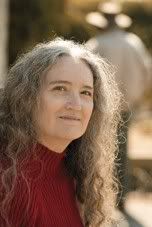
This photo was taken on Sunday afternoon, after the Esalen experience had ended.  Yes, I look tired, and I was tired.  It was a very intense experience, flying for the first time, seeing California for the first time, and meeting many new people.

Big Sur, of course, is so beautiful.  This photo was taken on Hwy 1, just outside of Esalen.  Driving the highway is exhilarating.  Often you can look out your window and see the cliffs dropping straight down to the ocean.  Every new turn presents something breathtaking.  I'd never seen anything like it before.

Esalen itself is a veritable utopia.  The sweet aroma of flowers mixed with the clean breeze off the pacific, the sound of the waves crashing on the rocks, and the generous nature of all participants felt marvelous, albeit a bit overwhelming.  Please understand, I'm one who is easily overwhelmed.  My preferred existence is quiet and calm.  My preferred existence is solitude.  So Esalen was a bit of a sensory overload for me.  It simply was almost too much for me to process, and I'm still working at taking it all in. 

I will say that I don't believe I've ever met so many kind, generous, and accepting people all in one place.  You felt like you could be completely yourself at Esalen. 

As some of you know, I was able to meet fellow blogger Vicky (My Incentive) at Esalen.  See her entry, "Too Full To Speak."  How strange is life.  Before The Sun invited me to Esalen to lead  workshops, I would have never dreamed I would meet Vicky in person.  She was an "Internet friend," precious but just a little bit abstract.  Even the snail mail we exchanged didn't quite quell the sense for me that Vicky was a far-off angel, precious but forever out of range.  Now we've met!  It was so easy to be with her, so comforting.  Vicky is so alive, and she is so easy to love.

The Sun had 80-something participants.  Each participant chose four workshops to attend during the weekend.  Workshops were scheduled on Saturday morning, Saturday afternoon, and Sunday morning.  I led three workshops--one on finding meaning in one's story, one on using the shadow in one's writing, and one on autobiographical fiction.

The participants were so open.  They were so guided by a spirit of discovery.  Although many came burdened by fears and doubts, most overcame them enough to create some stunning writing.  Those who were unable to write "on the spot" (I certainly could identify with them; I, too, have a hard time creating spontaneously) took with them the tools they needed to write in the comfort and privacy of their own space.

On Saturday night, the group leaders all read from their work.  I read from my novel, The Secret of Hurricanes.  Gillian Kendall read a piece previously published in The Sun.  Alison Luterman (who was my roommate) read powerhouse poems from her published collection, The Largest Possible Life.  David Romtvedt read poems from various published sources.  And the editor of The Sun, Sy Safransky, read his "Notebook" piece which appears in this month's (October 2005) Sun.  Sy's voice brings a wonderful gravity to what he writes. 

Hearing all the authors read from their work was, for me, like going to church, like experiencing an exceptional service, one you'll always remember.  Listening to the readers, I said to myself, This is how our stories and poems are supposed to be shared--out loud.    

How few opportunities really exist for this kind of encounter with writing, unfortunately.

I attended the AWP Writing Conference when it was in Chicago.  It fed my spirit, and I'd like to attend another AWP Conference someday, perhaps even lead a session there.  But Esalen was by far a better experience for me.  It was less "hurried," if that makes sense.  Although I was very busy working with groups and meeting people afterwards, I never felt rushed.  I never felt anxious in the same way I so often do in some academic situations. 

Yes, I was in my element at Esalen.  Yes, indeed.

Now that I'm home, I have to try to hold onto what Esalen gave me.  Not just hold onto it, but pass it on.

Tuesday, September 20, 2005

The Comfort of Art II

Okay, I promised to share more from Conversations with John Gardner.  Every once in a while my own well begins to run dry and at such times I visit Gardner for help and support.  Conversations is a new book of mine, and I'm finding it very useful.  I've read Gardner's works on writing for years, but the interviews in this book really help to bring out Gardner's personal side, his humanity.

The first interview in the book was done in 1973.  Gardner was interviewed by Joe David Bellamy.

During the interview, Bellamy asked what Gardner meant when he claimed that fiction should perpetuate "positive" moral values.  (People who know Gardner, know he wrote a book called On Moral Fiction, which caused an uproar when it came out.  The book suggested that much of our modern literature had lost its way, its purpose.).  Gardner was quick to point out that he wasn't advocating that writers should be judgmental or preachy.  Gardner replied that by "positive" he meant that the author should believe in generosity and hope and truth. 

He told Bellamy:  "The ultimate moral value, the moral value I really look for beyond anything else, is to be exactly truthful--seeing things clearly, the process of art."

I like this idea that the process of art helps us to see things clearly.

He then said he believed there comes a point in a writer's life when he or she becomes able to see the world clearly enough to write about it and to express something hopeful.  He said it feels to the writer as though he or she has flown above the world and is looking down on it from a high place. 

I have had this feeling!  But only within the last five or six years have I felt it.

Gardner said that  The writer uses his or her imagination to "redeem the world."

Isn't this the most amazing statement?

In order to be thiskind of writer, Gardner said, one needs faith.  This is what he said about faith:

"Faith and despair have always been the two mighty adversaries.  You don't have to see it in the way of a Christian, Hindu, Buddhist, or any other system.  A healthy life is a life of faith; an unhealthy sick, and dangerous life is a life of unfaith. ...Faith is a physical condition, a feeling of security which enables you to think about what you're doing and yet be subconsciously alert.  Whereas unfaith, paranoia, is a total concentration which makes it impossible for your psyche and body to be alert."

Writing is an act of faith--this is what I think Gardner was saying.  Through writing, we show our ability "to be patient, to be tolerant, to try to understand and empathize."  And this, he said, is "the highest kind of imagination." 

Moreover, writing displays the author's faith, his or her faith in what holds us together, in what gives life meaning.

Then he said something that just blew me away:

"The ability to make up grand images and to thrill the reader is a nice talent, but if it doesn't include love, it's nothing--mere sounding brass."

To that I say, Amen.

I probably won't post again until I return from Big Sur.   The days will be very full.  I'll be the leader for three workshops, one on finding significance in one's writing, one on the "shadow" in writing, and one on autobiographical fiction.  I will take lots of photos and share the experience with you when I get back.

Take care of yourselves, everyone.